Programme

FENS Regional Meeting 2019, Belgrade – Call for Symposia

CALL FOR SYMPOSIA by September 1st, 2018

The Serbian Neuroscience Society, National Neuroscience Society of Romania and Neuroscience Society of Turkey come together for the first time with the aim of boosting the development of neuroscience in the entire region by organising a meeting with an exciting programme reflecting the latest discoveries and technological developments.

Send your symposium!

Information

Enquiries

Lieu
Belgrade, Serbia, July 10-13, 2019

41st Annual Meeting of Japan Neuroscience Society (Neuroscience 2018)-Call for Travel Award Application

The 41st Annual Meeting of Japan Neuroscience Society (Neuroscience 2018) will be held at Kobe Convention Center in Hyogo, Japan, from July 26th to 29th, 2018.

Neuroscience 2018 offers Travel Awards to enthusiastic leading non-Japanese neuroscientists traveling from abroad to present high quality papers at the meeting. Applications of young principal investigators and senior postdoctoral fellows are especially encouraged. The funding for travel will be between 40,000-150,000 JPY per award depending on the travel distance. The awardees will also be exempt from the registration fee of the meeting. Those from Asian-Pacific countries are particularly encouraged.

Please be advised that persons from the following countries must apply for the Travel Award through their home Neuroscience Affiliations: China, South Korea, India, and Iran.

– The Japan Neuroscience Society (JNS) was founded in 1974. Since then, the membership has increased steadily. With more than 6,300 members in 2017, JNS is now a representative academic society in neuroscience in Japan.

– Neuroscience 2018 under the theme of “New Horizon of Neuroscience” provides a unique opportunity to forge closer links between researchers in different fields and to develop next-generation neuroscientists endowed with a wide perspective.

– Top international and domestic researchers will take this as an opportunity to elucidate the mechanisms of the brain and mind through promotion of a wide range of neuroscience research fields, across clinical medicine and psychology, and to the molecular and cellular biological levels.

– We will also focus our efforts on promoting interaction with relevant professional neuroscience societies in neighboring Asia-Pacific countries, the United States and Europe by organizing joint symposia and providing a financial assistance program to cover travel costs.

– All travel award winners are invited to the International Exchange Meeting for Young Researchers and a get-together party to be held on July 25th, 2018 to facilitate interaction among young researchers from abroad and Japan. In addition, they will be invited to a reception on DAY 2 of the Annual Meeting.

– The Annual Meeting aims at fostering young scientists and promoting collaboration across the globe and various scientific fields including clinical neuroscience. We expect approximately 4,000 participants, including 400 people from overseas.

– The Meeting will be held at Kobe Convention Center, Hyogo.

Website

Application deadline: January 9th, 2018.


Lieu
Center in Hyogo, Japan

Communicating Animal Research: Challenges and Opportunities

Dans le cadre du Forum FENS 2018, le FENS Committee on Animals in Research (CARE) et la European Animal Research Association (EARA) invitent les personnes impliquées dans la recherche animale en neurosciences à participer à la session « Communicating Animal Research: Challenges and Opportunities », dimanche 8 juillet, de 12h30 à 13h30.

Cette session sera présidée par Suliann BEN HAMED, membre CARE-FENS et correspondante CARE-Société des Neurosciences.

Voir le programme détaillé


Lieu
CityCube Berlin Berlin ExpoCenter City Messedamm 26, 14055 Berlin, Germany

École Thématique CNRS

Les canaux et transporteurs ioniques
du fondamental à l’appliqué : approches méthodologiques et concepts émergents

Cette école, ouverte à tous, a pour objectif d’aborder (en théorie et en pratique) concepts émergents et approches multi-méthodologiques pour l’étude des fonctions cellulaires associées aux canaux ioniques, de leurs rôles physiopathologiques et du criblage pharmacologique et phénotypique pour leur ciblage thérapeutique.

Le programme de l’école thématique sera articulé autour de trois grands axes organisés par journée et que les participants, répartis en trois groupes, suivront dans un ordre quelconque. Des séminaires scientifiques sur les applications des concepts et techniques abordés dans chaque axe auront lieu le vendredi matin.

Chaque axe comprendra des présentations des techniques abordées, suivis des ateliers pratiques sur les installations expérimentales.

Ces trois axes se définissent de la façon suivante :

  • AXE 1 – Le canal dans son environnement membranaire : courants ioniques, flux et criblage
  • AXE 2 – Le canal dans son environnement cellulaire : localisation et dynamique
  • AXE 3 – Le canal et ses impacts : migration/prolifération cellulaire et communication intercellulaire

Pour de plus amples informations, consulter le site internet de l’école.

Lieu
Laboratoire Signalisations et Transports Ioniques Membranaires (STIM) CNRS - ERL 7003 Pôle Biologie Santé, Université de Poitiers 1 Rue Georges Bonnet POITIERS

The cognitive thalamus

Neurex meeting

Organizers:
Jean-Christophe Cassel & Anne Pereira de Vasconcelos (LNCA, Strasbourg)

The thalamus – the largest diencephalic structure with its about 60 nuclei – has long been considered a structure bidirectionnally relaying information between subcortical and cortical regions. Over the two last decades, some of its nuclei have been recognized as having a major role in various aspects of cognition. Indeed, thalamic lesions are associated with a panel of cognitive dysfunctions including amnesia, aphasia, alterations in executive functions, attention, perseveration… in both neurological patients and animal models. Over the last five years, research in both humans and laboratory animals has provided new support (e.g., 136 research articles and reviews in 2017) pointing to a specific role of some of these thalamic nuclei in the dynamic interactions between limbic structures and cortical areas implicated in cognitive functions (e.g., hippocampus, prefrontal cortex). There will be a particular emphasis on processes underlying functions encompassing, for instance, behavioural flexibility, working memory, memory persistence… Data and arguments presented will come from MRI studies in humans and experimental approaches in animal models, including non human primates.

Detailed programme and registration

Lieu
Bâtiment Atrium 16 rue René Descartes 67081 Strasbourg

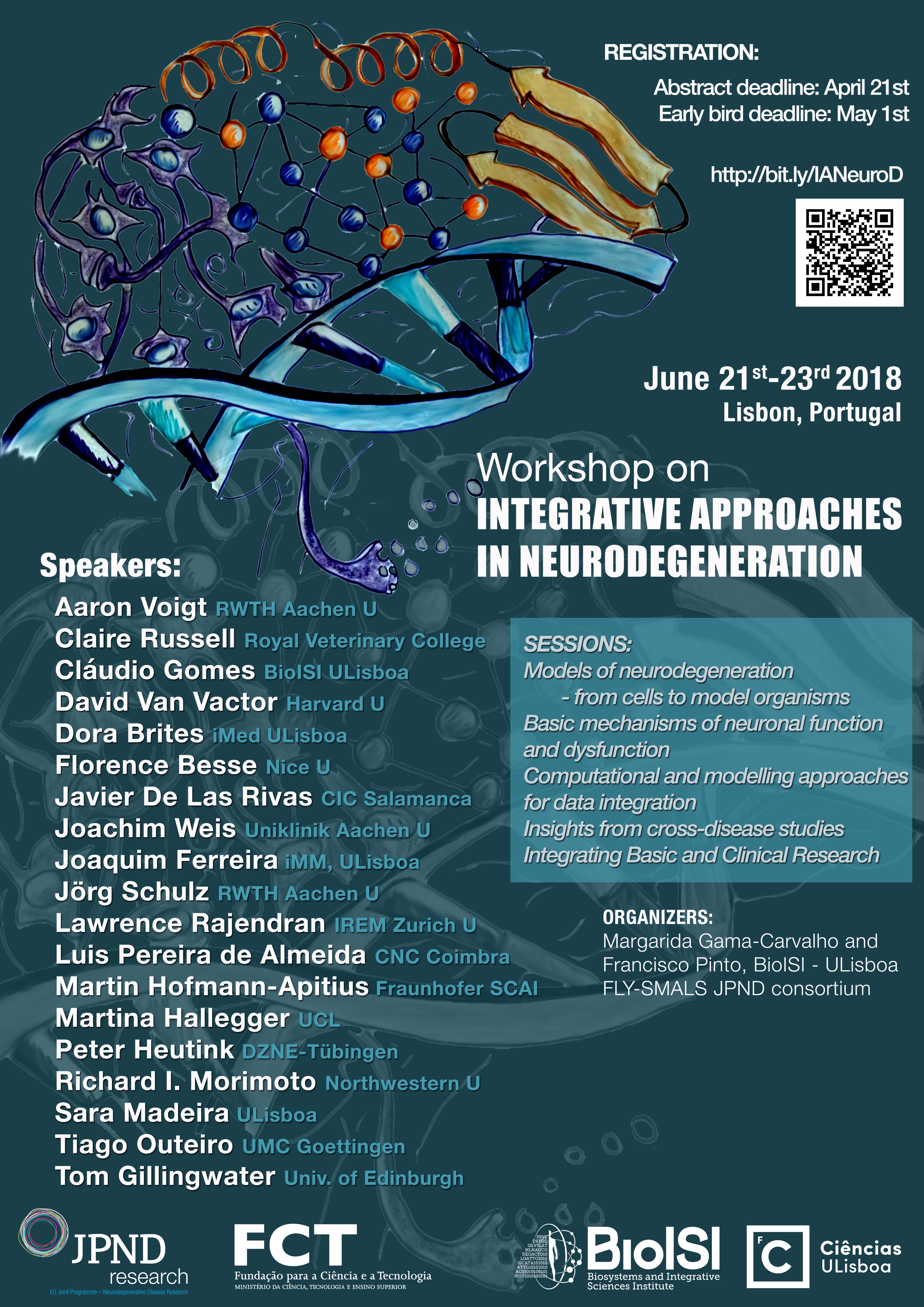
Workshop in Integrative Approaches in Neurodegeneration

The Workshop in Integrative Approaches in Neurodegeneration is organized in the frame of the FlySMALS consortium, funded by the 2013 JPND Transnational call for “European research projects for Cross-Disease Analysis of Pathways related to Neurodegenerative Diseases”, which come to an end this year. The workshop aims to disseminate and integrate the results of the research consortium with state-of-the-art research in the field, promoting the joint presentation and discussion of relevant research topics by a panel of international experts, including members of other consortia funded through the same JPND call.

The program targets a broad audience of basic, experimental, computational and clinical scientists, in the spirit of the JNPD Cross-Disease Analysis call, aiming to:
promote the analysis of diseases across traditional clinical boundaries
combine fundamental, pre-clinical and clinical experimental approaches  with computational approaches
re-define clinical phenotypes and new approaches in the treatment of neurodegenerative diseases
identify commonalities and differences molecular pathways underlying neurodegenerative diseases.

The workshop will bring together 20 invited speakers and  50 registered participants, providing an ideal environment for dynamic interactions promoting the exchange of expertise across areas, supporting the conceptual development of novel integrative research approaches that will contribute to the future progress in neurodegenerative disease research. Participants will be able to present their work at a poster section and through short talks from selected abstracts.

Join us in the wonderful city of Lisbon for an exciting inter-disciplinary program at the forefront of neurodegenerative disease research.

Further information.
Contact

Lieu
Lisbon Portugal

Réunion Francophone sur la maladie d’Alzheimer et Syndromes apparentés

Date limite d’inscription 31 mai 2018 (pour s’inscrire : cliquer ICI)

Le rôle essentiel des patients et des aidants dans la recherche (en partenariat avec les associations de familles et de patients) ;
Les spécificités des patients jeunes de la maladie d’Alzheimer ;
Les stratégies innovantes pour une approche transdisciplinaire de la maladie d’Alzheimer (en association avec le Labex DISTALZ) ;
Les facteurs de risque vasculaires ou métaboliques et les troubles cognitifs (en association avec le FHU VasCog) ;
La stratification et nosographie en recherche clinique et thérapeutique ;
Le « Big Data » et les nouvelles technologies ;
L’actualité en recherche fondamentale ;
Le diagnostic précoce au travers de cas clinico-pathologiques.
Une table ronde sur l’évolution du champ d’action des Centres Mémoire et Centres Mémoire de Ressources et de Recherche, un débat/controverse sur le lien entre diabète et maladie d’Alzheimer et une demi-journée de formation continue sur les démences lobaires fronto-temporales validant le parcours de Développement Professionnel Continu sont également proposés. Une large place est laissée aux communications libres orales et affichées.

Au plaisir de vous recevoir à Lille,

Le comité d’organisation de la RFMASA 2018

contact@rfmasa2018-lille.fr

Inscriptions & informations

Lieu
Lille

6th conference of the Association for Research in Neuroeducation

The 6th conference of the Association for Research in Neuroeducation will be held on June 6-8, 2018, at the Sorbonne in Paris, France, and organized by the Laboratory for the Psychology of the Child Development and Education (LaPsyDÉ) at the CNRS and the Paris Descartes University. The first day will consist of general public conferences (in French only) around the topic of « Neuroeducation: a new science for school? », and will aim to share and discuss the latest progress in the field of neuroeducation with students, teachers and other experts in education. The goal of this day will be to strengthen the links between the members of the educational community by facilitating the exchange of ideas and expertise and the dialog between the lab and the school. In addition to conferences given by several researchers in developmental psychology, education sciences and developmental cognitive neuroscience, round table sessions will allow to reflect on the future school.

The scientific symposium will be held over the following two days (Day 2 and 3), and will aim at presenting the findings of researchers who manage to reconcile the constraints of the cognitive neuroscience techniques with the investigation of questions in the field of education at school and at the university. Our keynote speaker will be Bert de Smedt, Associate Professor of Neuroscience at the Katholieke Universiteit Leuven (KUL).

For the scientific symposium, we welcome oral presentations submissions and poster submissions from researchers and students working in developmental psychology, education sciences and developmental neuroscience.
The online abstract submission is open until February 28th, 2018.
Abstracts should not exceed 300 words in length. The full abstract will be reviewed by the conference scientific committee and the result of this review will be communicated on March 28th, 2018.

For more information, visit the ARN 2018 conference website.

Lieu
Grand Amphithéâtre de la Sorbonne 75005 Paris

Ethique et neurosciences – L’interface homme-machine

En partenariat avec la Société des Neurosciences

Les enjeux des recherches en neurosciences sont de 2 ordres, étroitement liés. Il s’agit d’une part, de relever le défi de dévoiler l’organisation et le fonctionnement de l’organe complexe que représente notre cerveau et plus généralement de notre système nerveux, à toutes les étapes de la vie et dans ses nombreuses fonctions, ouvrant une fenêtre sur la connaissance du soi et de nos comportements. Cette connaissance, en dehors de tout contexte pathologique, permet d’envisager une amélioration de certaines de nos facultés pour favoriser l’épanouissement de la personne (mieux apprendre, communiquer, interagir avec notre environnement, etc.), sans pour autant chercher à dépasser nos limites biologiques comme le prône le transhumanisme. D’autre part, les neuroscientifiques tentent de répondre à des besoins thérapeutiques non satisfaits, avec la nécessité d’apporter de nouvelles options pour combattre les nombreuses atteintes et maladies qui affectent le système nerveux. Les conséquences entravent souvent l’autonomie relationnelle de la personne et altèrent sa qualité de vie. S’y ajoutent les coûts induits par le suivi médical, évalués dans la Communauté Européenne à près de 800 milliards d’Euros, soit plus d’un tiers des dépenses de santé. Devant l’afflux des données issues de la recherche en neurosciences, le développement d’outils permettant d’appréhender et de modifier le fonctionnement du système nerveux, et les implications sociétales de ces avancées, notre responsabilité de neuroscientifique est de soulever les nombreux questionnements éthiques qui se posent. Il convient de faire la part entre utilisation thérapeutique et cosmétique des données, les possibilités effectives et les fantasmes.
L’évocation de ces quelques aspects de la recherche développée dans le champ des neurosciences justifie une approche éthique appropriée. Il convient d’anticiper les conséquences et l’impact sociétal d’évolutions technologiques qui parfois peuvent être considérées intrusives, voire de nature à mettre en cause les libertés individuelles, faute d’un encadrement approprié. L’acceptabilité de ces avancées dont l’intérêt en termes de prévention et de traitements s’avère évident, est conditionné par le souci d’éviter tout risque de dérive ou d’usage inconsidéré. Les États généraux de la bioéthique peuvent favoriser une concertation indispensable entre chercheurs, praticiens, usagers de la santé et société, dans la perspective de développer une approche responsable de l’innovation en neurosciences.


Programme & inscriptions

Horaires
de 09 h à 17 h 30
Lieu
Ministère de l’Enseignement supérieur, de la recherche et de l’Innovation Amphithéâtre Poincaré, 1, rue Descartes 75005 Paris Avec la Société des Neurosciences

Spain & French Ms Meeting – Paris 2017 – Conference on Multiple Sclerosis

Organized by Fondation ARSEP and Esclerosis multiple España

  • 08:30 Registration
  • 09:00 Welcome address by Jean-Frédéric DE LEUSSE
  • 9:10 Actualities in MS predictive markers
  • Chairs: Jean PELLETIER and Alfredo ANTIGÜEDAD
  • 09:20 Hélène ZEPHIR (Lille, France): Clinical markers
  • 09:40 Lucia ROMERO PINEL (Barcelona, Spain): Biological markers
  • 10:00 Aurélie RUET (Bordeaux, France): MRI markers
  • 10:20 Coffee break
  • 11:00 Actualities in progressive MS
  • Chairs: Catherine LUBETZKI and Oscar FERNANDEZ
  • 11:10 José Carlos ÁLVAREZ-CERMEÑO (Madrid, Spain): Physiopathological aspects of MS progression as seen by a clinician
  • 11:40 Bruno STANKOFF (Paris, France): Mechanisms of disability worsening in MS: insight from imaging
  • 12:10 Posters teaser – all themes are welcome!
  • 13:30 Lunch & posters session
  • 15:00 Actualities in neurobiology & immunology
  • Chairs: David LAPLAUD & Manuel COMABELLA
  • 15:10 Luisa María VILLAR GUIMERANS (Madrid, Spain): Physiopathological aspects of MS progression as seen by a clinician
  • 15:40 Violetta ZUJOVIC (Paris, France): Interplay of innate and adaptive immune system to promote demyelination
  • 16:10 Prizes of the best poster and the best teaser
  • 16:30 End of the meeting

TRAVEL GRANTS FOR YOUNG RESEARCHER

Deadline for abstract submission : April 4, 2018

A quick presentation of the abstract will be done by each presenting author during the POSTER’S TEASER.

Deadline for registration (free but mandatory) : May 25, 2018

Information & Registration


Lieu
Institut des Cordeliers Paris