Programme

6th conference of the Association for Research in Neuroeducation

The 6th conference of the Association for Research in Neuroeducation will be held on June 6-8, 2018, at the Sorbonne in Paris, France, and organized by the Laboratory for the Psychology of the Child Development and Education (LaPsyDÉ) at the CNRS and the Paris Descartes University. The first day will consist of general public conferences (in French only) around the topic of « Neuroeducation: a new science for school? », and will aim to share and discuss the latest progress in the field of neuroeducation with students, teachers and other experts in education. The goal of this day will be to strengthen the links between the members of the educational community by facilitating the exchange of ideas and expertise and the dialog between the lab and the school. In addition to conferences given by several researchers in developmental psychology, education sciences and developmental cognitive neuroscience, round table sessions will allow to reflect on the future school.

The scientific symposium will be held over the following two days (Day 2 and 3), and will aim at presenting the findings of researchers who manage to reconcile the constraints of the cognitive neuroscience techniques with the investigation of questions in the field of education at school and at the university. Our keynote speaker will be Bert de Smedt, Associate Professor of Neuroscience at the Katholieke Universiteit Leuven (KUL).

For the scientific symposium, we welcome oral presentations submissions and poster submissions from researchers and students working in developmental psychology, education sciences and developmental neuroscience.
The online abstract submission is open until February 28th, 2018.
Abstracts should not exceed 300 words in length. The full abstract will be reviewed by the conference scientific committee and the result of this review will be communicated on March 28th, 2018.

For more information, visit the ARN 2018 conference website.

Lieu
Grand Amphithéâtre de la Sorbonne 75005 Paris

Ethique et neurosciences – L’interface homme-machine

En partenariat avec la Société des Neurosciences

Les enjeux des recherches en neurosciences sont de 2 ordres, étroitement liés. Il s’agit d’une part, de relever le défi de dévoiler l’organisation et le fonctionnement de l’organe complexe que représente notre cerveau et plus généralement de notre système nerveux, à toutes les étapes de la vie et dans ses nombreuses fonctions, ouvrant une fenêtre sur la connaissance du soi et de nos comportements. Cette connaissance, en dehors de tout contexte pathologique, permet d’envisager une amélioration de certaines de nos facultés pour favoriser l’épanouissement de la personne (mieux apprendre, communiquer, interagir avec notre environnement, etc.), sans pour autant chercher à dépasser nos limites biologiques comme le prône le transhumanisme. D’autre part, les neuroscientifiques tentent de répondre à des besoins thérapeutiques non satisfaits, avec la nécessité d’apporter de nouvelles options pour combattre les nombreuses atteintes et maladies qui affectent le système nerveux. Les conséquences entravent souvent l’autonomie relationnelle de la personne et altèrent sa qualité de vie. S’y ajoutent les coûts induits par le suivi médical, évalués dans la Communauté Européenne à près de 800 milliards d’Euros, soit plus d’un tiers des dépenses de santé. Devant l’afflux des données issues de la recherche en neurosciences, le développement d’outils permettant d’appréhender et de modifier le fonctionnement du système nerveux, et les implications sociétales de ces avancées, notre responsabilité de neuroscientifique est de soulever les nombreux questionnements éthiques qui se posent. Il convient de faire la part entre utilisation thérapeutique et cosmétique des données, les possibilités effectives et les fantasmes.
L’évocation de ces quelques aspects de la recherche développée dans le champ des neurosciences justifie une approche éthique appropriée. Il convient d’anticiper les conséquences et l’impact sociétal d’évolutions technologiques qui parfois peuvent être considérées intrusives, voire de nature à mettre en cause les libertés individuelles, faute d’un encadrement approprié. L’acceptabilité de ces avancées dont l’intérêt en termes de prévention et de traitements s’avère évident, est conditionné par le souci d’éviter tout risque de dérive ou d’usage inconsidéré. Les États généraux de la bioéthique peuvent favoriser une concertation indispensable entre chercheurs, praticiens, usagers de la santé et société, dans la perspective de développer une approche responsable de l’innovation en neurosciences.


Programme & inscriptions

Horaires
de 09 h à 17 h 30
Lieu
Ministère de l’Enseignement supérieur, de la recherche et de l’Innovation Amphithéâtre Poincaré, 1, rue Descartes 75005 Paris Avec la Société des Neurosciences

Spain & French Ms Meeting – Paris 2017 – Conference on Multiple Sclerosis

Organized by Fondation ARSEP and Esclerosis multiple España

  • 08:30 Registration
  • 09:00 Welcome address by Jean-Frédéric DE LEUSSE
  • 9:10 Actualities in MS predictive markers
  • Chairs: Jean PELLETIER and Alfredo ANTIGÜEDAD
  • 09:20 Hélène ZEPHIR (Lille, France): Clinical markers
  • 09:40 Lucia ROMERO PINEL (Barcelona, Spain): Biological markers
  • 10:00 Aurélie RUET (Bordeaux, France): MRI markers
  • 10:20 Coffee break
  • 11:00 Actualities in progressive MS
  • Chairs: Catherine LUBETZKI and Oscar FERNANDEZ
  • 11:10 José Carlos ÁLVAREZ-CERMEÑO (Madrid, Spain): Physiopathological aspects of MS progression as seen by a clinician
  • 11:40 Bruno STANKOFF (Paris, France): Mechanisms of disability worsening in MS: insight from imaging
  • 12:10 Posters teaser – all themes are welcome!
  • 13:30 Lunch & posters session
  • 15:00 Actualities in neurobiology & immunology
  • Chairs: David LAPLAUD & Manuel COMABELLA
  • 15:10 Luisa María VILLAR GUIMERANS (Madrid, Spain): Physiopathological aspects of MS progression as seen by a clinician
  • 15:40 Violetta ZUJOVIC (Paris, France): Interplay of innate and adaptive immune system to promote demyelination
  • 16:10 Prizes of the best poster and the best teaser
  • 16:30 End of the meeting

TRAVEL GRANTS FOR YOUNG RESEARCHER

Deadline for abstract submission : April 4, 2018

A quick presentation of the abstract will be done by each presenting author during the POSTER’S TEASER.

Deadline for registration (free but mandatory) : May 25, 2018

Information & Registration


Lieu
Institut des Cordeliers Paris

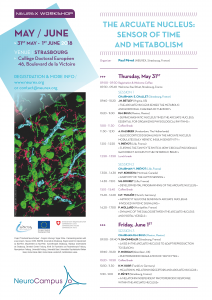
THE ARCUATE NUCLEUS: SENSOR OF TIME AND METABOLISM

Organizer Paul Pévet (NEUREX, Strasbourg, France)

REGISTRATION & MORE INFO: www.neurex.org or contact@neurex.org

>>> Thursday, May 31ST

09.00 – 09.30 Registration & Welcome Coffee

09.30 – 09.40 Welcome: Paul Pévet, Strasbourg, France

SESSION 1
CHAIRMAN: E. CHALLET (Strasbourg, France)

09.40 – 10.20 J.N. BETLEY (Virginia, US)
« THE ARCUATE NUCLEUS SENSES THE METABOLIC AND HORMONAL CHANGES OF THE BODY »

10.20 – 11.00 R.M. BUIJS (Mexico, Mexico)
« SUPRACHIASMATIC NUCLEUS TIMES THE ARCUATE NUCLEUS: ESSENTIAL FOR ORGANIZING PHYSIOLOGICAL RHYTHMS »

11.00 – 11.30 Coffee Break

11.30 – 12.10 A. KALSBEEK (Amsterdam, The Netherlands)
« GLUCOCORTICOID SIGNALING IN THE ARCUATE NUCLEUS MODULATES DAILY HEPATIC INSULIN SENSITIVITY »

12.10 – 12.50 V. PRÉVOT (Lille, France)
« FLIPPING THE TANYCYTE SWITCH: HOW CIRCULATING SIGNALS GAIN DIRECT ACCESS TO THE METABOLIC BRAIN »

12.50 – 13.50 Lunch break

SESSION 2
CHAIRMAN: V. PRÉVOT (Lille, France)

13.50 – 14.30 M.V. KOKOEVA (Montreal, Canada)
« ANATOMY OF THE LEPTIN SENSING »

14.30 – 15.10 S.G. BOURET (Lille, France)
« DEVELOPMENTAL PROGRAMMING OF THE ARCUATE NUCLEUS »

15.10 – 15.40 Coffee Break

15.40 – 16.20 M.T. TSCHÖP (Munich, Germany)
« ASTROCYT GLUCOSE SENSING IN ARCUATE NUCLEUAS INVOLVED IN POMC SIGNALING »

16.20 – 17.00 P. MOLLARD (Montpellier, France)
« DYNAMIC OF THE DIALOG BETWEEN THE ARCUATE NUCLEUS AND PORTAL VESSELS »

>>> Friday, June 1ST

SESSION 3
CHAIRMAN: R.M. BUIJS (Mexico, Mexico)

09.00 – 09.40 V. SIMONNEAUX (Strasbourg, France)
« A KISS IN THE ARCUATE NUCLEUS TO ADAPT REPRODUCTION TO SEASON »

09.40 – 10.20 P. MORGAN (Aberdeen, UK)
« PHOTOPERIODIC REGULATION OF TANYCYTES »

10.20 – 10.50 Coffee Break

10.50 – 11.30 H.W. KORF (Frankfurt, Germany)
« MELATONIN, MELATONIN RECEPTORS AND ARCUATE NUCLEUS »

11.30 – 12.10 P. PÉVET (Strasbourg, France)
« A MELATONIN INDEPENDENT PHOTOPERIODIC RESPONSE WITHIN THE ARCUATE NUCLEUS»

Lieu
Collège Doctoral Européen 46, Boulevard de la Victoire STRASBOURG

Eighth International Symposium on Biology of Decision-Making (SBDM)

The Eighth International Symposium on Biology of Decision Making will take place on
May 21-23, 2018 in Paris, France. The objective of this three-day symposium will be
to gather people from different research fields with different approaches
(psychology, economics, ethology, psychiatry, neural, behavioral, computational and
robotics approaches) to decision making.
The symposium will be a single-track, will last for 3 days and will include 6 sessions:
« Learning about the structure of the world to make decisions » (Chair: Chris
Summerfield) ;
« Constructing and deconstructing subjective value » (Chair: Lesley Fellows) ;
« The neuroscience of moral decision-making » (Chair: Miriam Teschl) ;
« Decision-making across cultures and species » (Chair: TBD) ;
« Dealing with uncertainty: exploration and curiosity » (Chair: TBD) ;
« Development and decision-making » (Chair: TBD) ;

IMPORTANT DATES
April 15, 2018 Deadline for Poster Submission
May 01, 2018 Notification of Poster Acceptance
May 08, 2018 Deadline for Registration
May 21-23, 2018 Symposium Venue


CONTACT INFORMATION
Website, registration, poster submission and detailed program

Contact

Téléphone : 01 44 27 28 85

Lieu
Paris ICM + ENS + Sorbonne Université + UPMC

Appel à bénévoles « Jardins ouverts » / FRC

La FRC organise une opération « Jardins ouverts » du samedi 5 mai au mardi 8 mai 2018 : une centaine de jardins ouvrent leurs portes au profit du Neurodon. Pour chaque entrée, 2€ sont reversés à la recherche sur le cerveau.

La FRC est à la recherche d’étudiants/chercheurs en neurosciences désireux de partager leurs connaissances, d’informer et de communiquer avec les visiteurs sur les neurosciences. Ce sera l’occasion pour eux de parler de leurs travaux, des neurosciences en général, d’expliquer l’importance de financer la recherche, mais également de répondre aux questions que les visiteurs peuvent se poser sur la recherche ou sur certaines maladies du cerveau.

Affiche et liste des jardins participant souhaitant accueillir des scientifiques pour cette opération.

Plus d’informations sur cette opération.


Lieu
Dans plus d’une centaine de jardin de Bretagne, Normandie, Pays de la Loire, Centre-Val de Loire, et aussi Île-de-France, Alsace, Picardie, Aquitaine et PACA

Brain Research in Europe: Shaping FP9 and Delivering Innovation to the Benefit of Patients

On the 23rd-24th April, the European Brain Council will hold a two-day event at the University Foundation in Brussels. The two days will include three separate but complementary sessions on “FP9 and Missions”, “The Value of Innovation”, and “Brain Research: Shifting Gears and Going Global”.

Investments into research and innovation have delivered unprecedented results for patients across Europe. Publicly and privately funded innovation schemes in the EU empowered researchers to accelerate scientific discovery, increase the understanding of non-communicable diseases and improve healthcare services. Yet despite the progress that was achieved in recent decades, there is currently no effective treatment to cure a wide range of mental and neurological conditions. What is more, the complexity of many brain disorders hinders researchers in their efforts to develop innovative healthcare interventions.

In 2018, the European Commission is expected to submit proposals for a mission-oriented and impact-focused 9th Framework Programme. In view of the preparations for the forthcoming EU research scheme, the European Brain Council (EBC) aims to bring attention to issues that affect therapeutic innovation and facilitate an exchange of views on how the post-2020 Framework Programme can make a real difference for patients living with brain disorders.

The event will allow leading healthcare stakeholders and policymakers to address key questions in the domain of research, such as: how can the 9th Framework Programme accelerate brain research across Europe? What measures can be taken in order to stimulate the development of new central nervous system drugs for treating brain disorders? What can be done to address the concerns of patients?

23 April 2018, 14:30-18:00
FP9 & Missions

24 April 2018, 10:00-14:00
The Value of Innovation

14:00-17:00
European Brain Research: Shifting Gears and Going Global

Please confirm your attendance by filling in the online registration form.

Additional information can be found on the EBC website.

Lieu
European Brain Council University Foundation Rue d’Egmont 11 BE-1000 Brussels

French Club of Glial Cells – Annual Meeting, October 9th, 2018

The annual meeting of the French Club of Glial Cells will be held on October 9th, 2018 in Paris at the Brain & Spine Institute. This meeting will highlight the most recent findings in the glial field and promote scientific exchanges and collaborations among the neuroscience community.

The annual meeting of the French Club of Glial Cells will be held on October 9th, 2018 in Paris at the Brain & Spine Institute. This meeting will highlight the most recent findings in the glial field and promote scientific exchanges and collaborations among the neuroscience community.

Keynote speakers
Gonçalo Castelo-Branco, Karolinska Institute, Sweden
Transcriptional and epigenetic states of oligodendrocyte lineage cells in the central nervous system
Giles Hardingham, University of Edinburgh, UK
Signalling to and from astrocytes in health and disease

Call for Oral/ Poster presentations
We welcome submissions of oral and poster presentations from researchers and students. The basic criteria for selection are the scientific quality, the ability of the speaker to present their work to a broad and multidisciplinary audience. Abstracts should include title, list of authors, affiliations and a summary that should not exceed 500 words in length. The scientific committee of the CCG 2018 will review abstracts and notification of acceptance will be sent by June 30th, 2018.

Deadline for abstract submission: June 1st, 2018.

Abstracts should be sent to Thierry Amédée.

Lieu
Institut du Cerveau et de la Moelle Epinière – ICM, Paris

Recherche thérapeutique et modèles animaux

L’’Académie des sciences et l’’Académie nationale de médecine sont heureuses de vous convier à la conférence-débat  Recherche thérapeutique et modèles animaux qui se tiendra le mardi 10 avril 2018 de 14h30 à 17h00 dans la grande salle des séances.

Programme

A cette occasion, Angela Sirigu, Bernard Meunier, Xavier Montagutelli et Pierre Corvol, évoqueront les aspects réglementaires et éthiques de l’’utilisation des modèles animaux ainsi que les progrès médicaux qu’’ils ont permis.

Les inscriptions sont ouvertes au public dans la limite des places disponibles. Si vous souhaitez y assister, nous vous prions de vous inscrire en remplissant notre formulaire en ligne.

Plan d’accès

Lieu
Grand salle des séances Institut de France 23, quai de Conti 75006 Paris

Réunion Francophone sur la Maladie d’Alzheimer et Syndromes Apparentés

APPEL A COMMUNICATION

Chers collègues,

Nous nous permettons de vous rappelez que la prochaine Réunion Francophone sur la Maladie d’Alzheimer et Syndromes Apparentés se tiendra du 11 au 14 juin prochain à Lille.

Vous êtes cordialement invités à soumettre vos travaux pour des présentations orales ou poster pour le 26 mars au plus tard.

Vous pouvez déposer votre résumé à abstract@rfmasa2018-lille.fr

Au programme de cette édition 2018, nous vous proposons les thématiques suivantes.

Le rôle essentiel des patients et des aidants dans la recherche (en partenariat avec les associations de familles et de patients) ;
Les spécificités des patients jeunes de la maladie d’Alzheimer ;
Les stratégies innovantes pour une approche transdisciplinaire de la maladie d’Alzheimer (en association avec le Labex DISTALZ) ;
Les facteurs de risque vasculaires ou métaboliques et les troubles cognitifs (en association avec le FHU VasCog) ;
La stratification et nosographie en recherche clinique et thérapeutique ;
Le « Big Data » et les nouvelles technologies ;
L’actualité en recherche fondamentale ;
Le diagnostic précoce au travers de cas clinico-pathologiques.
Une table ronde sur l’évolution du champ d’action des Centres Mémoire et Centres Mémoire de Ressources et de Recherche, un débat/controverse sur le lien entre diabète et maladie d’Alzheimer et une demi-journée de formation continue sur les démences fronto-temporales validant le parcours de Développement Professionnel Continu sont également proposés. Une large place sera laissée aux communications libres orales et affichées.

Nous vous serions reconnaissants de bien voir transmettre cette information autour de vous,

Au plaisir de vous recevoir à Lille !

Le comité d’organisation de la RFMASA 2018

Contact

Site

Lieu
Lille