Programme

Conférence Jacques Monod – Protein phase transitions in ageing and age-related diseases: from atomic resolution to cellular solutions

Protein phase transitions in ageing and age-related diseases: from atomic resolution to cellular solutions

Cells and organisms maintain protein homeostasis in several cooperating ways, which include protein folding, degradation, and sequestration. During aging, the capacity to maintain protein homeostasis declines, which leads to the accumulation of aggregation-prone proteins. These aggregation-prone proteins can accelerate aging and cause age-related diseases like Parkinson’s disease, tauopathies, Alzheimer’s, and Amyotrophic Lateral Sclerosis. How they do so is still not fully understood. Understanding the underlying mechanisms will be important for the development of therapeutic strategies. Recent groundbreaking discoveries have revealed new aspects of protein homeostatic and pathological mechanisms. These include the phenomena of protein phase transitions in membrane-less organelles and the existence of amyloid polymorphisms that are associated with protein toxicity. These phenomena are shared by a range of stress and age-related conditions. This Jacques Monod meeting will highlight these phenomenon, including the biological mechanisms and structural features involved. New findings will be presented by scientists that pioneered the research in these areas. Regulation of both physiological and disease-related transitions will be addressed as well as perspectives on biomedical applications.

The meeting will bring together leading experts in the fields of structural biology, cell biology, physiology and medical biology. It aims to foster exchange of knowledge across these fields and to stimulate interdisciplinary collaboration to further advance the filed.

Registration request and abstract submission deadline: JUNE 13th 2022 (might be postponed)

More information here:

Protein phase transitions in ageing and age-related diseases: from atomic resolution to cellular solutions | INSB (cnrs.fr)

Les changements de phase des protéines au cours du vieillissement et des maladies associées au vieillissement:de la structure atomique aux solutions cellulaires – Sciencesconf.org


Lieu
Station biologique de Roscoff, Place Georges Teissier, Roscoff (Bretagne), France
Paiement
Registration fee (including board and lodging) 470 € for PhD students 760 € for other participants

Conférence « Le coeur neuronal : une histoire de Rythme » (Axe Rythmologies de la MSH-Alpes par Philippe Chevalier, Prof de Cardiologie

https://www.msh-alpes.fr/recherche/seminaires/rythmologies

Il existe une interaction complexe entre le cœur et l’encéphale, en particulier dans le cadre d’émotions. Il a été démontré que la colère ou la joie ont un impact significatif sur le rythme cardiaque. Non seulement les émotions chargées négativement entraînent une vasoconstriction et une libération de catécholamines, mais elles ont également un effet significatif sur les indices électriques cardiaques. Il semble aussi que les mécanismes de rétroaction afférents cardiaques entraînent des changements dans les régions corticales cérébrales.  Les oscillations du rythme cardiaque sont donc essentielles à connaître pour le soignant.
Horaires
Mardi 11/10 2022 de 11h à 13h (avec discussion)
Lieu
Visioconférence Zoom
Public cible
Conférence destinée à un large public académique.

ÉCOLE DE RECHERCHE TRANSLATIONNELLE EN NEUROSCIENCES 2022

En partenariat avec le GIS Autisme et troubles du Neuro-developpement, l’ITMO NNP offre une opportunité unique aux jeunes cliniciens ou chercheurs de s’immerger dans le monde de la recherche translationnelle en Neurosciences.
Cette école est ouverte aux chercheurs récemment recrutés (depuis 2020) dans l’un des organismes de recherche membres d’Aviesan (Inserm, CNRS, Université, etc…), ainsi qu’aux internes et chefs de clinique de spécialités en relation avec le cerveau/système nerveux (neurologie, psychiatrie, …).

Les frais de transport et d’hébergement seront pris en charge par l’ITMO NNP.

Voir le programme.
Retrouvez les détails et le dossier de candidature sur le site de l’ITMO NNP.

Lieu
Château de Suduiraut 33210 Preignac

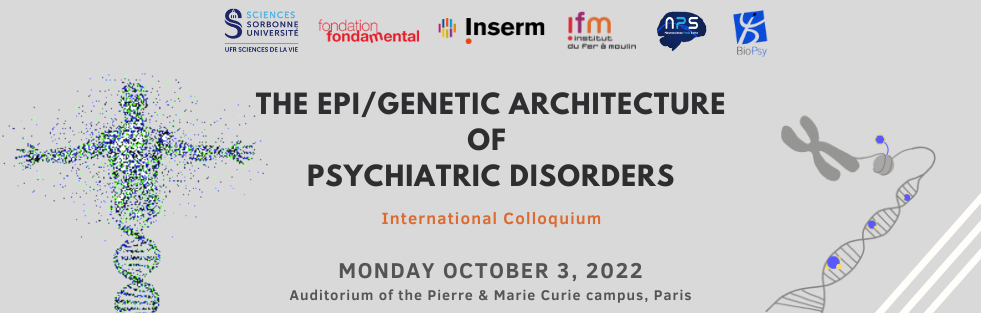
International colloquium « Epi/genetic architecture of psychiatric disorders »

Colloque international autour de la contribution des facteurs génétiques et épigénétiques à l’architecture des troubles psychiatriques.

Bannière Epigenpsy

Le colloque international “Epi/genetic architecture of psychiatric disorders” aura lieu le Lundi 3 octobre 2022 dans l’auditorium du campus Pierre et Marie Curie de Jussieu, à Paris.

Ce colloque sera à la fois le colloque de clôture du Labex Bio-Psy (retardé par la pandémie) et un colloque exceptionnel de l’IFM (Institut du Fer à Moulin) et de NPS (Neurosciences Paris Seinte – IBPS) soutenu par la Fondation FondaMental et l’UFR des Sciences de la Vie de la Faculté des Sciences et d’Ingénierie de Sorbonne Université.

Les intervenants présenteront un résumé des avancées récentes et confronteront leurs points de vue sur la contribution des facteurs génétiques et épigénétiques à l’architecture des troubles psychiatriques. Du temps sera également consacré aux présentations de posters et aux échanges.

L’inscription est gratuite et obligatoire (collations incluses). Pour vous inscrire, soumettre vos posters ou toute autre information pratique, rendez-vous sur le site epigenpsy.sciencesconf.org !

> Téléchargez le flyer <
> Téléchargez le programme <

Horaires
09:30 - 19:00
Lieu
Centre International de Conférence Sorbonne Université Auditorium du Campus Pierre & Marie Curie "Jussieu" 4 place Jussieu, 75005 Paris
Public cible
Psychiatric disorders, Brain development, Genetics, Epigenetics, Neurology

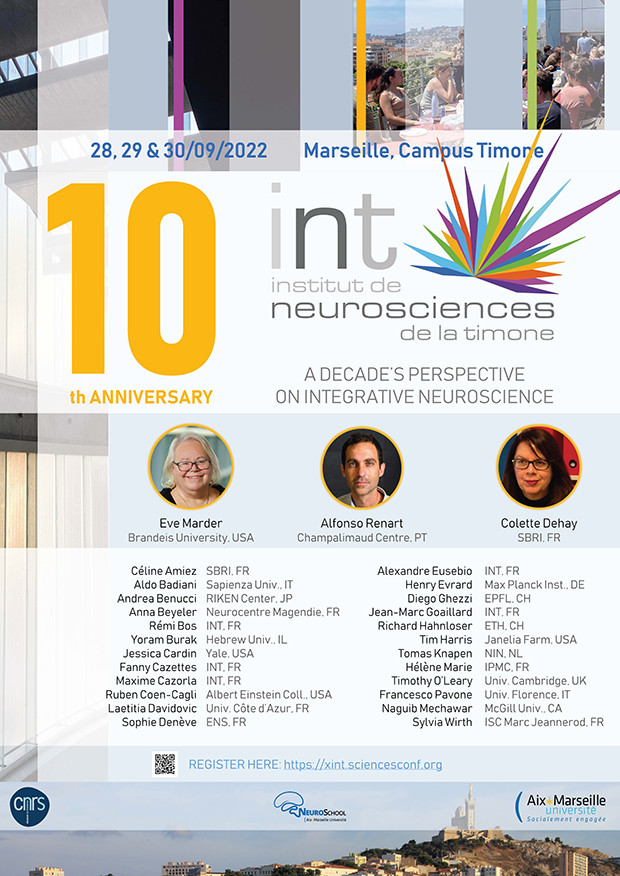
10th Anniversary Institut de Neurosciences de la Timone – A decade’s Perspective on Integrative Neuroscience

This 5th edition of the international conference of the Institute de Neurosciences de la Timone also marks the 10th anniversary of the INT.

The conference program illustrates the scientific approach pursued since 2012. First, our goal was to promote scientific exchanges between the different levels of approach to the nervous system, from the molecule to behavior, in animals and in humans. Second, our strategy was to put at the heart of these cross-fertilization the functional role of large and small networks, in order to better understand the relationships between the brain and cognition. Finally, our ambition was to put these relationships, with their diversity and variability, into a physiological perspective in order to always remember that neurons do not function alone, that the brain is best understood as being part of an organism and that behavior is always a part of a natural repertoire. These three pillars are at the core of our basic research projects but also our clinical research, as the pathologies of the nervous system keep challenging each of our a priori ideas about how the brain works. The four sessions of the Conference illustrate these different questionings.

Registrations are opened at https://xint.sciencesconf.org

Lieu
Campus de la Timone Marseille
Public cible
Neuroscience community

Sondage pour l’organisation des journées annuelles C-BRAINS

https://forms.gle/zUXEQSyWApMUdwdB9

Le DIM C-BRAINS vise à renforcer l’attractivité et la visibilité des neurosciences et sciences cognitives en Ile de France.

Il rassemble plus de 200 équipes de recherche, 41 partenaires industriels et 19 associations.

Pour renforcer les échanges au sein de la communauté C-BRAINS, nous organisons 2 journées de rencontre, en région parisienne,  durant la semaine du 06 février 2023.
Afin de définir au mieux le programme de ces journées, nous souhaitons recueillir les attentes de l’ensemble de la communauté C-BRAINS via le formulaire ci-dessous :

https://forms.gle/zUXEQSyWApMUdwdB9

Nous avons probablement oublié des personnes donc nous vous remercions de diffuser le formulaire à l’ensemble des collègues qui portent un intérêt au projet C-BRAINS.

Nous vous joignons également le flyer du projet C-BRAINS.

L’avis de l’ensemble des partenaires compte !
Le formulaire sera clôturé le 30/09 à minuit.

Au nom du comité d’organisation de ces journées.

Sophie Bouton, Valérie Doyère, Grégory Gauvain, Sabir Jacquir

(Le formulaire sera clôturé le 30/09 à minuit).

Summer school: Advanced tools for data analysis in Neuroscience – 2022

New and innovative methods for data analysis in Neuroscience

Research discoveries are increasingly dependent on the development of new tools and technologies, as well as on the ability to process, manage and analyze the large amounts of data collected with these tools.

In this summer school, we will focus on several aspects of data preparation and analysis, as well as on the use of simulation and modeling tools capable of generating predictions. These tools will be applied to different data acquisition techniques such as electrophysiological recordings (e.g. EEG, intra or extracellular recordings) or image series from brain imaging (e.g. MRI).

Target audience:

Master and PhD students from the University of Strasbourg and other French and foreign universities are welcome to apply.

Priority will be given to students enrolled in a basic or medical neuroscience program, but students from other specialties will be able to participate as long as places are available.

There is no registration fee.

During the school (Sep. 5-10th), accomodation (but not travel) during the school (but not pre-school) will be offered to non-Strasbourg students. Accomodation expenses during the pre-school and travel for the entire event are to be borne with own fundings.

Students are encouraged to come with their own dataset.

How to apply:

1 – Send an email to philippe.isope@inci-cnrs.unistra.fr to express your intention to apply

2 – When ready, send your CV and a letter of recommendation to philippe.isope@inci-cnrs.unistra.fr

Full application deadline: May 15,2022.


Lecturers involved:

Demian Battaglia (LNCA,CNRS,Université de Strasbourg)
Samuel Garcia (CRNL, CNRS, Université de Lyon)
Romain Goutagny (LNCA,CNRS,Université de Strasbourg)
Axel Hutt (MIMESIS,INRIA, Université de Strasbourg)
Philippe Isope (INCI, CNRS,Université de Strasbourg)
Arvind Kumar (KTH, Stockholm, Sweden)
Christophe Pouzat (IRMA, CNRS, Université de Strasbourg)

Horaires
9- 6 PM
Lieu
Université de Strasbourg, France
Public cible
Master and PhD students from the University of Strasbourg and other French and foreign universities are welcome to apply.
Paiement
Free registration

Women in Neuroscience Symposium 2022

The Women in Neuroscience Symposium 2022, held virtually from 12-14 August 2022 in Georgia. This symposium will be held simultaneously with the Women’s Neuroscience Festival and supported by the International Brain Research Organization (IBRO).

We have considered some special facilities for national neuroscience associations; our center offers a 50% discount on the registration fees to all members of the Société des Neurosciences.

Find out more

Template_Panel Proposal form


Lieu
Online

Glial Social event at FENS 2022

This Glial Social will be an excellent opportunity for networking and conviviality around glia science. Details at: https://club-de-cellules-gliales.assoconnect.com/collect/description/243340-o-glia-social-fens?iframe=1

The SpanishPortuguese and French Glial Cell Clubs invite you to the Glial Social to gather the European glia community during the FENS meeting. This event will take place at the Institut du Cerveau (ICM) in Paris, and is sponsored by Networkglia and the GLIA Journal.

An interactive historical lecture on myelin will be given by Dr. Boris ZALC (ICM) and followed by glial interactions (games). There will be a buffet with organic, and veggie-friendly food, drinks, and music!

Horaires
The Glial Social will start at 7:30 pm on July 12th 2022. 
Lieu
Institut du Cerveau (ICM), Paris.

FENS Forum 2022

Get ready to take an active role at Europe’s largest international neuroscience conference, covering all domains in modern brain research from basic to translational research!

Organised by FENS in partnership with the Société des Neurosciences, the event will feature high-quality science from every domain of modern brain research. Over the course of five days, attendees will have unprecedented access to a range of symposia, technical workshops, plenary lectures and poster sessions. There will be multiple occasions throughout the meeting to shape the programme and share your research with your peers. Also on the agenda are a number of social events and networking opportunities to get to know your colleagues in a more casual setting.

Early registration and abstract submission open!

Visit the FENS Forum 2022 website and follow FENS on social media to stay updated (#FENS2022).


Lieu
Paris Expo Porte de Versailles 1 Pl. de la Porte de Versailles 75015 Paris, France