Programme

Du cerveau aux neurosciences. Itinéraires dans la longue durée

3e journée d’étude du Comité pour l’histoire de l’Inserm
En partenariat avec Sorbonne Université et l’UMR SIRICE

sur une proposition de Yves Agid.

Elle réunira des historiens, des chercheurs en sciences humaines et sociales, des acteurs contemporains et des personnalités de l’Inserm concernés par les neurosciences.

22 janvier 2020 de 9 h à 18 h

Les neurosciences occupent une place croissante au sein de la recherche médicale et scientifique. Plus qu’une discipline, elles articulent un ensemble de champs liés à la connaissance du cerveau et du système nerveux et interrogent les rapports complexes de l’homme à son environnement et à ses semblables. De la recherche biomédicale aux sciences cognitives, acteurs, démarches et organisations qui structurent les neurosciences sont diverses. Souvent convergentes, elles peuvent également s’avérer concurrentes. Alors que les découvertes et les défis des neurosciences sont relayés par les médias, ce domaine entre espoir et inquiétude suscite l’intérêt croissant du grand public. Au prisme des dernières techniques de l’imagerie médicale, le cerveau fascine. De manière désordonnées et, parfois, mal informées, les « neurosciences » semblent partout… Intégrées, parfois sans discernement, dans nombre de débats, elles sont mobilisées à propos des enjeux de société et de santé publique, d’éducation, de vieillissement et nourrissent chez certains les espoirs d’un homme « augmenté ». Un regard plus réfléchi ne serait-il pas dès lors nécessaire ?

C’est par l’histoire que la troisième journée d’étude du Comité pour l’histoire de l’Inserm espère favoriser une réflexion plus sereine. Elle abordera tout d’abord l’évolution de la connaissance, de l’exploration et des représentations du cerveau du xvie siècle aux dernières innovations du xxie siècle. La construction historique de la définition de la maladie et de l’élaboration des thérapeutiques articulée à la mise en place d’un encadrement institutionnel et hospitalier, sera ensuite interrogée, en posant la question de la place et de la représentation des patients au sein du système de santé, et plus largement de la société.

Ce rendez-vous constituera un nouveau temps de rencontre et d’échanges entre historiens, chercheurs en sciences humaines et sociales, témoins, scientifiques et acteurs institutionnels et associatifs. En tournant leur regard vers le passé, ils auront à l’esprit les problématiques actuelles … et porteront ainsi l’espoir de mieux discerner les enjeux des temps futurs.

Pour en savoir plus

Entrée libre sur réservation (selon les places disponibles)

Pour s’inscrire, contactez le secrétariat scientifique

Consultez le programme

Télécharger l’affiche

Lieu
Amphithéâtre Michelet - Sorbonne 46 Rue Saint-Jacques - Paris 5e

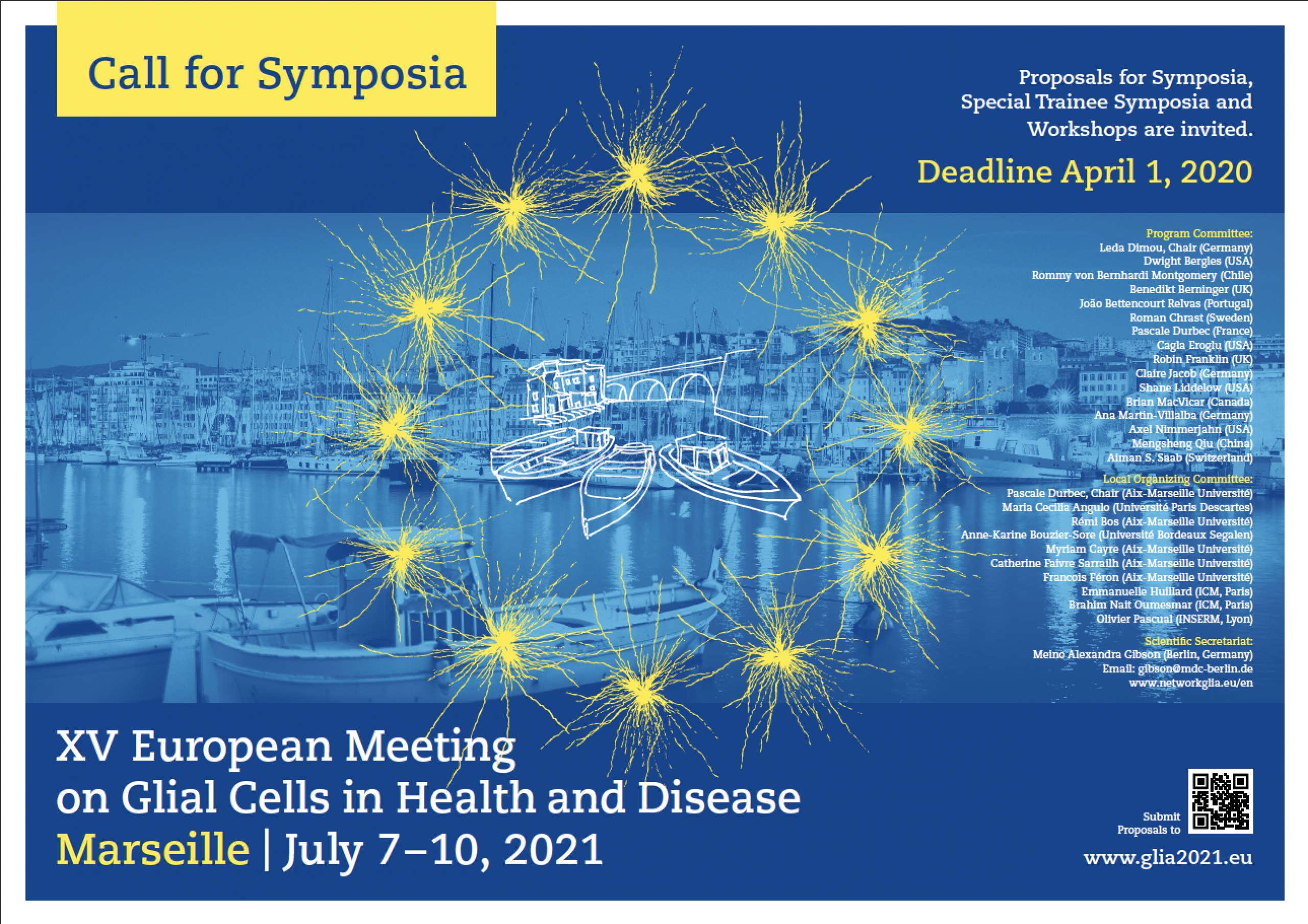
XV European Meeting on Glial Cells in Health and Disease – Call for symposia

The XV European Meeting on Glial Cells in Health and Disease will be held in Marseille, France on July 7 – 10, 2021.

We encourage members of the glial community to propose Symposia, Special Trainee Symposia or Technical workshops on all aspects of CNS and PNS glial biology. The guidelines for symposium proposals and the web form for submitting proposals can be found on the meeting’s website.

The deadline for submission is Wednesday, April 1, 2020, 12.00 p.m. / midnight (CET)

The European Glial Meeting has become the world’s largest and most comprehensive scientific gathering on glial cell biology and medicine. The Glial Meeting series has become a tradition since the first gathering in 1994 at the University of Heidelberg. Subsequent Glial Meetings have been held throughout Europe every second year. After the outstanding success of the Glia Meeting 2019 in Porto with more than 1.500 participants, the conference returns to France after the meetings in Arcachon (1996) and Paris (2009) and it will be hosted in Marseille, the second-largest city in France. Marseille is famous for its seafood and the classic Bouillabaisse. This cosmopolitan city has much to offer, from ancient history and cultural diversity to unique seaside scenery and lovely Mediterranian weather.

Lieu
Marseille

NeuroFrance 2021 – Appel à propositions de symposiums

Le prochain colloque biennal de la Société des Neurosciences aura lieu à Strasbourg en mai 2021.

L’appel à propositions de symposium débutera le 13 janvier 2020.
Réfléchissez dès à présent aux propositions que vous souhaitez soumettre !

Consultez le site web du colloque


Lieu
Palais de la Musique et des Congrès Place de Bordeaux 67000 Strasbourg

XV European Meeting on Glial Cells in Health and Disease

Dear Glia Community,

The XV European Meeting on Glial Cells in Health and Disease will be held in Marseille, France on July 7 – 10, 2021.

We encourage members of the glial community to propose Symposia, Special Trainee Symposia or Technical workshops on all aspects of CNS and PNS glial biology. The guidelines for symposium proposals and the web form for submitting proposals can be found on the meeting’s website. The deadline for submission is

Wednesday, April 1, 2020, 12.00 p.m. / midnight (CET)

The European Glial Meeting has become the world’s largest and most comprehensive scientific gathering on glial cell biology and medicine. The Glial Meeting series has become a tradition since the first gathering in 1994 at the University of Heidelberg. Subsequent Glial Meetings have been held throughout Europe every second year. After the outstanding success of the Glia Meeting 2019 in Porto with more than 1.500 participants, the conference returns to France after the meetings in Arcachon (1996) and Paris (2009) and it will be hosted in Marseille, the second-largest city in France. Marseille is famous for its seafood and the classic Bouillabaisse. This cosmopolitan city has much to offer, from ancient history and cultural diversity to unique seaside scenery and lovely Mediterranian weather.

Hope to see you there!

https://www.glia2021.eu

Lieu
MARSEILLE CHANOT, PALAIS DES CONGRÈS ET DES EXPOSITIONS Rond Point du Prado 13008 Marseille

15e Rencontre annuelle du Club de Neuroprotection

La 15e journée annuelle du Club de Neuroprotection sera consacrée à LA PHYSIOPATHOLOGIE ET LE TRAITEMENT DES MALADIES NEURODEGENERATIVES à la lumière de la GENETIQUE . (programme ci-joint), et à quelques communications orales libres ( à vos candidatures).

Consultez le programme

Fiche d’inscription

Lieu
Amphithéâtre de l'Institut de myologie Hôpital de la Pitié Salpêtrière Paris XIII

16th INTERNATIONAL SYMPOSIUM ON CHOLINERGIC MECHANISMS

16th INTERNATIONAL SYMPOSIUM ON CHOLINERGIC MECHANISMS
2nd MISRAHI SYMPOSIUM ON NEUROBIOLOGY

16th INTERNATIONAL SYMPOSIUM ON CHOLINERGIC MECHANISMS
2nd MISRAHI SYMPOSIUM ON NEUROBIOLOGY

Welcome to the XVIth International Symposium on Cholinergic Mechanisms (ISCM-XVI), scheduled for December 8th-13th, 2019. The symposium will be held in the Lopatie Conference Center on the campus of the Weizmann Institute of Science, in Rehovot, Israel.

The first International Symposium on Cholinergic Mechanisms (ISCM) was organized by the late Edith Heilbronn. It took place in Skokloster, Sweden, in 1970. The ISCMs have been held triennially since then, the most recent being ISCM-XV, in Marseille, in October, 2016. The principal objective of these conferences is to survey progress in the understanding of the molecular, cellular, pharmacological, toxicological, behavioral and clinical aspects of the cholinergic system, and to bring fundamental and applied scientists together so as to survey and discuss the most recent developments in cholinergic research. It has also been a tradition to publish the proceedings, so as to provide a comprehensive picture of the cholinergic field at the time of the symposium.

http://www.weizmann.ac.il/conferences/ISCM-XVI_2019/

Lieu
The David Lopatie Conference Centre, on the campus of the Weizmann Institute of Science, Rehovot, Israel.

26th Meeting (RT26) of the French Society of Toxinology (SFET)

The 26th Meeting (RT26) of the French Society of Toxinology (SFET) will take place on December 4-5, 2019, in the François Jacob auditorium of the Pasteur Institute in Paris, and will focus on a theme at the heart of the current research in toxinology: “Bioengineering of Toxins”.

We warmly invite you to attend the meeting, or better: present your own data as an oral communication or a poster!

Website

Key dates:
Early bird registration: September 30, 2019
Submission of an abstract for an oral presentation: October 15, 2019
Submission of an abstract for a poster presentation: October 30, 2019


Lieu
Auditorium François Jacob, Institut Pasteur Paris

Le Congrès du Sommeil

Palais des congrès de Lille accueillera du 21 au 23novembre, le Congrès du Sommeil®.

Le programme préliminaire est maintenant disponible sur les site du congrès : http://www.lecongresdusommeil.com

Manifestation parrainée par la Société des Neurosciences

Lieu
LILLE GRAND PALAIS 1, Boulevard des Cites-Unies 59777 EURALILLE

Reward – 6th Bordeaux Neurocampus conference

The Bordeaux Neurocampus Conferences are a serie of Neuroscience meetings, organized in Bordeaux, France.

The purpose of the conferences is to present and discuss recent findings in a topic field in Neuroscience, bringing together leading international experts and young researchers. The maximum number of participants is 250, including invited speakers. The scientific program is organized jointly by members of Bordeaux Neurocampus and the LabEx Brain.

The Bordeaux Neurocampus Conferences are 3-day meetings that take place in autumn at Bordeaux University, France. About 20 presentations are given by invited speakers, and the schedule encourages lively discussion, in particular during the poster sessions.

NEXT CONFERENCE : 2-4 OCTOBER, 2019
Normal and pathological reward processing: from synapse to behavior
Essential feature of the human as well as the animal brain is its ability to process information on-line in order to efficiently adapt behavior to a changing environment. The brain constantly integrates new sensory information and adjusts its behavioral responses to maximize reward and / or minimize unpleasant and even dangerous consequences for the organism. The question here is to highlight brain regions that share the ability to “reward” the performance of vital functions such as feeding, exploration of new environments, initiation of new social interactions, reproduction and appropriate reaction to threat? The mesocorticolimbic dopaminergic system was the first neural circuit to be described in this context and is closely related to the whole reward system. Are there other brain reward systems? What happens in the brains of patients with autism spectrum disorders, addiction to drugs or sports, anxiety or depressive symptoms, Parkinson’s disease, whose reward system is altered? Answers to these questions do not reach consensus and will be debated during the three days of this conference.

Registration and abstract submission

Lieu
Domaine du Haut-Carré Talence