Programme

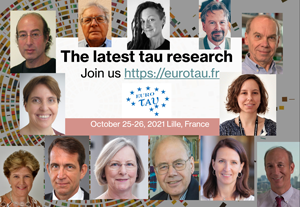
Eurotau2021 meeting

https://eurotau.fr


October 25, 2021

Welcome address:

8:30-9:00 – Luc Buée and RCF representative

9:00-11:00 Session 1 (Chairs: A. Rovelet-Lecrux & J. Attems)

9:00 – Johannes Attems (UK) Tau in ageing/ AD/ PART and frontotemporal lobar degeneration
9:15 – Anne Rovelet-Lecrux (France) Clinical and neuropathological diversity of tauopathy in MAPT duplication carriers
9:30 – Ruiqing Ni (Switzerland) High-resolution non-invasive whole brain optoacoustic tomography imaging of tau in P301L tauopathy mice
9:40 – Tiago Gil Oliveira (Portugal) Primary age-related tauopathy (PART) and Alzheimer’s disease show differential magnetic resonance imaging atrophy patterns
9:50 – Eugeen Vanmechelen (Belgium) Two plasma p-tau SIMOA-based assays using a shared synthetic calibrator peptide for detection of AD pathology
10:00 – Roberto Simone (UK) Natural antisense transcripts containing an embedded mammalian-wide interspersed repeat repress MAPT translation and aid proteostasis in neurodegeneration
10:15 – Karine Cambon (France) Neuronal Tau pathology transfers to astrocytes and induces their loss according to Tau aggregation state in mouse models
10:25 – Kevin Richetin (Switzerland) Tau accumulation in astrocytes of the dentate gyrus induces neuronal dysfunction and memory deficits in Alzheimer’s disease
10:35 – Michael Heneka (Germany-Luxembourg) How microglia modulate tau pathology
10:50 – Questions
11:00-11:30 Coffee break

11:30-13:00 Rainwater Prize ceremony

11:30 – Introduction
11:35 – Richard Carmona – Prize overview
11:50 – Philippe Amouyel (Chairperson: L Buée) – JPND & European funding for NDD
12:15 – Celeste Karch, Rainwater Prize for Innovative Early Career Scientist  (Chair: Leonard Petrucelli)
12:30 – David Holtzman, Rainwater Prize forOutstanding Innovation in Neurodegenerative Disease Research  (Chairperson: Howard Feldman)
12:45 – Todd and Matt Rainwater thank winners, nominators, scientists
12:55 – Amy Rommel – About prize & nominations open
12:59 – Luc Buee closes the Rainwater Ceremony
13:00-14:30 Lunch & Poster exhibition

14:30-16:00 Session 2 (Chairs: A. Rommel & L. Buée)

14:30 – David Holtzman, 2020 Rainwater Prize forOutstanding Innovation in Neurodegenerative Disease Research (USA)
14:50 – Michel Goedert, 2019 Rainwater Prize forOutstanding Innovation in Neurodegenerative Disease Research (UK) Cryo-EM structures of amyloid filaments from human brain
15:10 – Celeste Karch, 2020 Rainwater Prize for Innovative Early Career Scientist (USA) Molecular and cellular drivers of tauopathy
15:30 – Mathieu Bourdenx (France) Chaperone-mediated autophagy: a gatekeeper of neuronal proteostasis
15:40 – Wiep Scheper (The Netherlands) Cell type-specific proteostatic responses to tau pathology
15:50 – Lukasz A Joachimiak (USA) DnaJC7 binds natively forlded structural elements in tau to inhibit amyloid formation
16:00-16:30 Coffee break

16:30-18:00 Session 3 (Chairs: I. Landrieu & Y. Fichou)

16:30 – Illana Gozes (Israel) Novel insights to ADNP/NA/Tau protein interactions dictating brain development and aging
16:40 – Eliana Nachman (Belgium) Disassembly of Tau fibrils by the human Hsp70 disaggregation machinery generates small seeding-competent species
16:50 – François Devred (France) Three zinc binding sites of Tau and their role in tau aggregation
17:00 – Cláudio M. Gomes (Portugal) Dynamic interactions and Ca2+-binding modulate the chaperone activity of S100B preventing tau aggregation and seeding
17:10 – Davide Tampellini (France) Enhancement of synaptic stimulation induces tau clearance via the autophagosomal/lysosomal pathway
17:20 – Marina Rierola (Germany) Tau shapes microtubule-dependent transport in the dendrites
17:30 – Laura Vallés Saiz (Spain) Tau expression in the kidney: cell distribution and physiological function
17:40 – Marie Galas (France) Revisiting the link between tau and the neuronal cell cycle in Alzheimer’s disease: an unexpected role for nuclear tau
17:50 – Mahmoud Maina (UK / USA) The involvement of Tau in nucleolar function and stress response
18:00-20:00 Rainwater Prize reception (OPEN to all Eurotau participants)

October 26, 2021
8:30-9:00 – Plenary lecture

Kenneth Kosik (USA) A Rite of Passage: Tau’s Route Between And Within Cells

9:00-11:00 – Session 4 (Chairs: A. Mudher & I. Ferrer)

9:00 – Eckhard Mandelkow (Germany) Recent insights into Tau seeding and phosphorylation
9:15 – Louise Serpell (UK) The role of the core of tau paired helical filaments in AD and other tauopathies
9:25 – Yann Fichou (France) Tau intertwines with cofactors: how it modulates complex phase separation, oligomerization & aggregation properties
9:35 – Susanne Wegmann (Germany) Condensating the interactions of tau
9:45 – Amrit Mudher (UK) Tau aggregation and spread of pathology in Drosophila
9:55 – Isidre Ferrer (Spain) Importance of host tau in tau seeding and spreading in tauopathies
10:05 – Marie-Ange De Fisenne (Belgium) Alzheimer PHF-tau do not spread tau pathology to the brain via the retinotectal pathway after intraocular injection in mouse models
10:15 – Marc Dhenain (France) Induction of tau lesions in amyloid-bearing mice and in primates after inoculation of Alzheimer brain extracts
10:25 – Evgeni Ponimaskin (Germany) Amelioration of Tau pathology and memory deficits by targeting serotonin receptors
10:35 – Diane Hanger (UK) Truncated tau as a model of human tauopathy
10:50 – Questions
11:00-11:30 Coffee break

11:30-13:00 Session 5 (Chairs: D. Hanger & E. Mandelkow))

11:30 – Selected communication
11:40 – Selected communication
11:50 – Selected communication
12:00 – Selected communication
12:10 – Selected communication
12:20 – Selected communication
12:30 – Selected communication
12:40 – Selected communication
12:50 – Questions
13:00-14:30 Lunch & Poster exhibition

14:30-16:00 Session 6 (Chairs: S. Wegmann & M. Dhenain)

14:30 – Karen Duff (UK) Mechanistic underpinnings of selective cellular vulnerability to tauopathy
14:45 – Elodie Leroux (France) Extracellular vesicles and tau seeding among tauopathies
14:55 – Dirk Beher (Switzerland) OGA inhibitors as multimodal drug candidates for tau- and alpha-synucleinopathies15:30 – –
15:10 Norbert Zilka (Slovakia) Tau vaccine AADvac1 trains immune system to produce therapeutic antibodies against disease tau species in Phase II clinical trial
15:25 – Isabelle Landrieu (France) Single domain antibody fragments: new tools for studying Tau as a target for therapy
15:35 – John Sotiropoulos (Portugal) A novel method of spontaneously-released extracellular vesicles isolation from mouse and human brain
15:45 – Marco Luppi (Italy) Deep hypothermia stimulates a neuroprotective process reversing the accumulation of hyperphosphorylated tau protein in the rat hippocampus
15:55 – Questions
16:00-16:30 Coffee break

16:30-17:00 Session FLASH TALKS (Chairs: to be confirmed)

16:30 – Flash talk – selected poster
16:35 – Flash talk – selected poster
16:40 – Flash talk – selected poster
16:45 – Flash talk – selected poster
16:50 – Flash talk – selected poster
16:55 – Flash talk – selected poster

17:00 Poster prize


Lieu
Lille

Atelier “Cerveau – microbiote”

Les Interactions réciproques entre le Cerveau et le Microbiote suscitent un intérêt croissant dans la communauté scientifique et chez le grand public.

Pour répondre à cette demande, l’Institut Thématique Multi – Organisme (ITMO) Neurosciences, Sciences Cognitives, Neurologie, Psychiatrie, avec la participation des ITMOs Physiopathologie, Métabolisme, Nutrition et Immunologie, inflammation, infectiologie et microbiologie, organise un atelier « Cerveau-Microbiote ».

Cet atelier vise à réunir des scientifiques (chercheurs, étudiants, ingénieurs) de ces champs disciplinaires, déjà impliqués dans ce nouveau domaine de Recherche ou souhaitant développer des travaux dans celui-ci. Il est également ouvert aux personnes ayant un intérêt marqué pour ce domaine.

L’atelier se tiendra à l’amphithéâtre Buffon, à Paris, et sera également retransmis en direct en ligne.

Pré-programme

Inscription

Lieu
Amphithéâtre Buffon, à Paris & en direct en ligne

4th JOINT FRANCO-BRITISH MEETING OF NEUROENDOCRINOLOGY

REGISTRATIONS and ABSTRACT SUMMISSIONS ARE OPEN

The neuroendocrinologists in Bordeaux have the honor to organize in 2021 the 4th joint meeting between the SNE (French Society for Neuroendocrinology) and the BSN (British Society for Neuroendocrinology).

The congress will last 3 full days, from the 22nd to the 24th of September 2021, and will be entirely online. The scientific program elaborated by both the SNE’s and BSN’s scientific committees includes 4 plenary lectures and 4 symposia. The objective of the meeting is to highlight the recent advances in Neuroendocrinology with the best specialists in the field.

Plenary lectures:

Joëlle Cohen-Tannoudji, Waljit Dhillo, Sakina Mhaouty-Kodja, Steve A. Brown

Symposia:

-Development and Plasticity of Neuroendocrine Systems Involved in Metabolic Regulation

-Towards a dynamical understanding of stress, sleep, and metabolism

-Emerging concepts in the central control of fertility or of ovulation

-New insights in the hypothalamic circuitry regulating energy metabolism: physiological and pathophysiological implications

Young researchers will have the opportunity to present their work either through a short oral communication or during one of the three poster sessions of our meeting. The best posters and oral communications will be selected for a special prize. Young researchers will also have the opportunity to discuss with Journal editors, established senior and junior researchers and researchers from private companies through a speed networking event.

All details can be found on the conference website: BSN-SNE 2021

Organizing team:

-MP Moisan, Nutrineuro
-D Cota, NCM
-X Fioramonti, Nutrineuro
-Ph Ciofi, NCM
-M Darnaudery, Nutrineuro

Lieu
The congress will be entirely online

SUMMER SCHOOL “ADVANCED TOOLS FOR DATA ANALYSIS IN NEUROSCIENCE”

Research discoveries are increasingly dependent on the development of new tools and technologies, as well as on the ability to process, manage and analyze the large amounts of data collected with these tools.

In this summer school, we will focus on several aspects of data preparation and analysis, as well as on the use of simulation and modeling tools capable of generating predictions. These tools will be applied to different data acquisition techniques such as electrophysiological recordings (e.g. EEG, intra or extracellular recordings) or image series from brain imaging (e.g. MRI).


Target audience:

Master and PhD students from the University of Strasbourg and other French and foreign universities. Priority will be given to students enrolled in a basic or medical neuroscience program, but students from other specialties will be able to participate as long as places are available.

There is no registration fee.

Scholarships of 500 euros will be offered to non-Strasbourg students to cover travel and accommodation costs.

Students are encouraged to come with their own dataset.


How to apply:

Send your CV, a cover letter and a letter of recommendation to contact@neurex.org

Application deadline: May 15,2021.

More information

Lieu
Strasbourg (France)

Travel Awards – 44th Annual Meeting of Japan Neuroscience Society

The 44th Annual Meeting of Japan Neuroscience Society will be held at Kobe Convention Center, Hyogo, Japan from July 28 to 31, 2021. We offer Travel Awards to enthusiastic leading non-Japanese investigators traveling from abroad to present high quality papers at the meeting. Applications of young principal investigators and senior postdoctoral fellows are especially encouraged.

Travel Award Application

Registration: December 1st, 2020 to January 12th, 2021 at noon JST

Lieu
Hyogo, Japan

Conférence Science Ouverte, Lente, et Durable en langue Française

L’Association Slowpen Science, en partenariat avec le Laboratoire de Psychologie des Pays-de-la-Loire (LPPL, EA 4638), PROGEDO-Loire, et la MSH Ange-Guépin, est heureuse de vous annoncer la toute première édition de la conférence Science Ouverte, Lente, et Durable en langue Française, du 19 au 21 juillet 2021 à la MSH de Nantes.

Cette conférence a pour objectif d’échanger à propos des avancées et défis associés à la science ouverte, à la science lente, et à la science durable dans le cadre de l’étude des comportements, de la cognition et des émotions. De nombreux changements de pratiques de recherche sont apparus dans le paysage scientifique ces dernières années. Comment la communauté scientifique francophone européenne participe-t-elle à ces avancées ? Quels projets peut-elle initier afin d’améliorer la qualité des travaux scientifiques à venir ? Ce sont ces questions qui motiveront les échanges lors de cette conférence.

Les communications orales (format LONG ou ÉCLAIR) et les ateliers (PRATIQUE ou PROJET) seront regroupés dans des sessions thématiques et répartis sur trois jours.

Plus d’informations sur les différents formats.

Pour plus d’information ou pour soumettre votre proposition de communication (possible du 1er mars au 16 avril minuit), vous pouvez vous rendre sur le site de la conférence.

N’hésitez pas à nous contacter d’ici là pour toutes questions sold2021@sciencesconf.org ou sur Twitter @SlowpenScience (#sold21).

Le comité d’organisation
Amélie Beffara Bret, Université de Nantes
Bertrand Beffara, CRNL, CNRS, INSERM, UCBL1, Lyon
Brice Beffara Bret, Université de Nantes
Yseult Héjja-Brichard, CEFE, CNRS, Université de Montpellier, Université Paul Valéry Montpellier 3, EPHE, IRD, Montpellier
Ladislas Nalborczyk, GIPSA-lab, CNRS, Univ Grenoble Alpes, Grenoble INP

Lieu
MSH de Nantes

Journées Neurosciences Psychiatrie Neurologie (JNPN)

L’édition 2021 des Journées de Neurosciences, Psychiatrie et Neurologie (JNPN), en juillet prochain à Paris a l’ambition de nous donner l’occasion de nous retrouver, d’échanger, de confronter des perspectives différentes pour nous enrichir… et pas seulement parler de la pandémie… Nous voulons être pluridisciplinaires, nous voulons renforcer les liens entre scientifiques et cliniciens, entre professionnels du cerveau et praticiens de l’esprit.

Pourquoi venir aux JNPN 2021 ?

Parce que vous êtes un clinicien et que la pratique s’enrichit des interactions avec les chercheurs dans les domaines des neurosciences mais aussi des sciences humaines.

Parce que neurologue ou psychiatre, vous êtes persuadés que l’échange et la pluridisciplinarité sont les piliers de la pratique médicale d’aujourd’hui et de demain.

Parce que vous êtes un chercheur et que partager vos travaux et les confronter avec la réalité clinique vous paraît essentiel et fructueux.

Et parce que Paris est depuis toujours un creuset de savoir et de culture !

Le programme : “Le cerveau en partage”

JNPN

Lieu
Paris, Palais des Congrès

The 11th International Symposium of the society for Research on Cerebellum and Ataxias

In 2020 we had to postpone the physical SRCA Symposium scheduled in Pilsen, Chech Republic due to the COVID-19 pandemic. Today, the pandemic situation is different in every country but in general we are going in the right direction. But not quickly enough to organise the 2021 edition of the SRCA Symposium in a physical way.

In practice this means that the 11th edition of the International Symposium of the Society for Research on the Cerebellum and Ataxias on the 18 and 19 June 2021 will be a complete Virtual Meeting.

The virtual symposium will run over 2 days and consist of live presentations followed by live discussions, including the F. Rossi Lecture. These will be joined by pre-recorded oral contributions that will be available on the website. To upgrade the poster section, we will introduce the poster-on-demand sessions. In these sessions the pre-recorded presentations of the poster authors’ contribution will be available as video-on-demand on the website together with the abstract related to the poster. That way all posters will be available before, during and after the symposium and will be full presentations.

The symposium Organising committee is currently finishing the faculty of the meeting and as soon as all the titles of the keynote lectures have been finalised we will be able to announce the detailed scientific programme.

Call for abstracts : Online abstract submission

11th International Symposium of the Society for Research on the Cerebellum and Ataxias

Journée de Neurologie de Langue Française

Fondées en 1996, les Journées de Neurologie de Langue Française (JNLF) ont pour principaux objectifs de promouvoir et de développer la neurologie, en France et dans les pays francophones, de favoriser les relations et les échanges entre les diverses sociétés et associations s’intéressant au système nerveux, et de contribuer au fonctionnement des différents modes d’exercice de la pratique neurologique.

Depuis sa création, l’Association assure l’organisation annuelle de journées d’enseignement comprenant des cours, conférences, ateliers, communications affichées. Ces journées (« les JNLF ») sont devenues pour les près de 3000 congressistes et partenaires « le rendez-vous incontournable de la neurologie francophone ».

Le congrès e-Jnlf se tiendra – en ligne – du 26 au 28 mai 2021. Profitez, depuis chez vous, du meilleur de la Neurologie francophone !

Découvrez le programme interactif de 2021.

Lien d’inscription